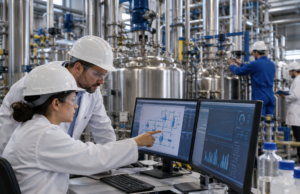
Chemical manufacturing has always demanded precision. A small variation in temperature, mixing time, raw material quality, or equipment performance can influence the outcome of an entire production run. For decades, manufacturers managed these variables through skilled operators, carefully documented procedures, laboratory testing, and increasingly sophisticated industrial equipment. Information technology is now adding another layer of control.
Modern IT systems allow chemical producers to collect information from equipment, analyze production data, monitor inventory, document quality standards, coordinate scheduling, and respond to problems faster than traditional paper-based or disconnected systems allow. The result is a manufacturing environment in which production teams have more information available before, during, and after every batch.
This shift is particularly important for companies providing Toll Chemical Manufacturing services. These manufacturers may work with different formulations, production requirements, packaging specifications, raw materials, and customer expectations from one project to the next. Technology provides a way to manage that complexity while maintaining consistency and traceability.
The broader importance of digital technology continues to receive extensive coverage across major technology publications, including Reuters technology coverage, as manufacturers in nearly every sector invest in automation, artificial intelligence, connected equipment, cybersecurity, and data-driven operations.
Manufacturing Is Becoming a Data-Driven Operation
For much of industrial history, manufacturing knowledge existed primarily in operating procedures, laboratory records, maintenance logs, and the experience of skilled employees. Those resources remain important, but digital systems make it possible to capture operational information continuously.
Sensors connected to production equipment can record temperature, pressure, flow rates, vibration, energy consumption, mixing speeds, and other operating conditions. That information can then be stored, reviewed, and compared with historical production data.
Instead of waiting until the end of a process to determine whether something went wrong, operators can identify changes while production is underway.
The concept is part of the larger world of information technology, which includes the computer systems, communications infrastructure, software, and data-processing technologies businesses use to collect, store, process, and distribute information.
Inside a chemical facility, the practical value of IT comes from connecting information that previously may have existed in separate places. Production schedules can interact with inventory systems. Equipment data can support maintenance planning. Laboratory results can be associated with individual batches. Shipping information can be tied directly to production records.
When these systems work together, managers gain a clearer picture of what is happening across the plant.
Automation Is Making Production Faster and More Consistent
Automation has been part of chemical manufacturing for decades, but modern information systems are expanding what automation can accomplish.
Programmable logic controllers, industrial control systems, distributed control systems, sensors, and manufacturing software can work together to control increasingly complex processes. Operators still play an essential role, but repetitive monitoring and adjustments can often be handled automatically within established operating limits.
The result can be greater consistency between batches.
A computerized control system, for example, can maintain a specified mixing speed or temperature according to predetermined production parameters. Sensors can continuously provide feedback, allowing the system or operator to identify deviations sooner.
Technology publications such as Ars Technica’s Biz & IT coverage regularly document developments involving computing infrastructure, enterprise technology, cybersecurity, automation, and other technologies that increasingly affect industrial operations.
The advantages of automation are not limited to speed. Consistency matters just as much.
Customers outsourcing production generally expect the finished material to meet the same specifications from one order to the next. Digital controls and production records help manufacturers document how batches were produced and determine whether operating conditions remained within defined parameters.
Automation also gives production employees better information. Instead of manually checking dozens of individual measurements, operators can monitor dashboards that organize critical production variables in one location.
Real-Time Monitoring Can Reduce Costly Production Problems
Manufacturing problems become more expensive the longer they remain undetected.
A mechanical problem discovered immediately may require a relatively straightforward repair. The same problem discovered after an entire production batch has been completed could result in downtime, wasted materials, additional laboratory testing, disposal costs, or delayed customer orders.
Real-time monitoring changes the timing of that response.
Connected sensors can provide continuous information about equipment and operating conditions. Software can compare incoming information against established limits and generate alerts when unusual conditions appear.
This capability is also contributing to the growth of predictive maintenance.
Traditional maintenance often follows either a reactive model, in which equipment is repaired after something fails, or a preventive model, in which components are serviced according to predetermined schedules. Predictive systems add operating data to the process.
Changes in vibration, temperature, electrical consumption, pressure, or other measurements can sometimes indicate developing equipment problems. Maintenance teams can investigate those changes before a failure disrupts production.
Enterprise technology developments involving data platforms, artificial intelligence, cloud computing, and automation are frequently covered by TechCrunch Enterprise. Many of the same technologies transforming corporate IT departments are increasingly finding practical applications within industrial environments.
For chemical manufacturers, avoiding unplanned downtime can be especially valuable because production schedules often involve coordinated deliveries of raw materials, equipment availability, employee scheduling, laboratory testing, packaging, and transportation.
One unexpected equipment failure can affect every stage that follows.
Digital Systems Improve Quality Control and Traceability
Quality control depends on accurate information.
Chemical manufacturers may need to document raw material sources, batch numbers, production dates, operating conditions, laboratory results, packaging information, and other details associated with an order.
Digital recordkeeping makes that information easier to organize and retrieve.
A well-integrated production system can create a digital history for each batch. If a customer needs information months later, employees can retrieve relevant records without searching through disconnected spreadsheets or paper files.
Traceability becomes particularly important when manufacturers handle multiple products or formulations.
Raw materials arriving at a facility can be assigned digital lot numbers. Those materials can then be associated with specific production batches. Laboratory results can be attached to the corresponding batch records. Packaging and shipping information can complete the digital trail.
This creates a more structured record of how a product moved through the manufacturing process.
IT systems can also support quality teams by making trends easier to identify. If a particular measurement begins changing gradually across several production runs, software can help reveal the pattern before it develops into a larger quality issue.
The connection between technology, business operations, data, and automation is also a major focus of WIRED’s technology and business reporting. Digital transformation is increasingly less about adopting individual pieces of software and more about connecting information throughout an organization.
Artificial Intelligence Is Expanding the Value of Manufacturing Data
Industrial facilities can generate enormous amounts of information. Collecting data is useful, but the larger opportunity lies in determining what that information means.
Artificial intelligence and machine learning tools are beginning to help companies analyze patterns that would be difficult to detect manually.
A manufacturing system may collect thousands of measurements across multiple production runs. Analytical software can compare those measurements with quality results, equipment performance, energy consumption, processing times, and other variables.
Over time, manufacturers may be able to identify relationships between operating conditions and production outcomes.
AI can also support forecasting.
Historical order information, material consumption, supplier lead times, seasonal demand, and production schedules can be analyzed to help purchasing and operations teams plan more effectively. Better forecasting may reduce the risk of both material shortages and unnecessary inventory.
The rapid development of AI and connected technology remains a major subject across The Verge’s technology reporting, reflecting how quickly intelligent software is moving into everyday business operations.
In industrial settings, however, AI does not need to replace employees to provide value. One of its most practical roles is helping experienced professionals work with larger amounts of information.
A maintenance technician can receive better equipment data. A plant manager can see production trends more clearly. A quality team can review patterns across batches. A purchasing department can make decisions using more complete inventory information.
Human expertise remains central to the process, while software provides additional visibility.
Cybersecurity Is Becoming Part of Plant Security
Connecting industrial equipment to computer networks creates advantages, but it also creates responsibilities.
A modern manufacturing facility may contain office computers, cloud applications, production-management software, industrial control systems, connected sensors, wireless devices, and remote-access technologies. Every connection must be managed carefully.
Cybersecurity is therefore becoming an operational concern rather than simply an IT department issue.
Manufacturers must consider access controls, employee permissions, software updates, network segmentation, backups, authentication practices, and procedures for responding to security incidents.
Production environments require particular care because reliability and safety are critical.
A compromised business computer can cause serious disruption. A compromised system connected to manufacturing equipment could create additional operational risks.
Major technology news organizations regularly report on vulnerabilities, software exploits, ransomware, data theft, and attacks against connected systems. Recent coverage from Reuters on technology and digital security illustrates how cybersecurity has become intertwined with broader technology adoption across industries.
For manufacturers, digital transformation must therefore include both connectivity and protection. More data can improve operations, but only when systems are designed and maintained with security in mind.
Cloud Technology Is Improving Communication Across the Supply Chain
Chemical production rarely operates in isolation.
Customers, suppliers, laboratories, logistics providers, warehouse personnel, production teams, purchasing departments, and management may all need access to different pieces of information.
Cloud-based software can make that coordination easier.
Authorized employees can access production schedules, inventory information, documents, customer records, or performance dashboards without relying entirely on information stored on individual computers.
Cloud systems can also support organizations operating multiple facilities or working with customers in different locations.
A sales employee may review the status of an order without contacting the plant floor. Purchasing personnel can see inventory requirements. Management can review production activity across multiple operations.
Better access to information can reduce delays created by internal communication.
It also changes customer expectations.
Businesses increasingly expect faster responses, clearer order information, better documentation, and greater visibility from suppliers. Manufacturers with connected information systems may be better positioned to provide that level of service.
Technology news coverage increasingly reflects this convergence between traditional industries and digital infrastructure. IT is no longer limited to companies that sell software, computers, or online services. It has become part of transportation, energy, healthcare, agriculture, logistics, construction, and manufacturing.
Smarter Technology Still Depends on Skilled People
The growth of industrial technology does not eliminate the value of manufacturing experience.
Software may detect an unusual temperature pattern, but experienced personnel still need to understand what that pattern means in the context of the process. Automated systems can control equipment, but engineers and operators establish operating procedures and determine acceptable limits.
Technology is most useful when it strengthens human decision-making.
This creates another challenge for manufacturers: workforce development.
Production employees increasingly need a combination of mechanical, chemical, operational, and digital skills. Maintenance technicians may work with both physical machinery and computerized diagnostic systems. Operators may monitor automated control interfaces. Managers may rely on dashboards and analytics when making production decisions.
Facilities that successfully combine experienced employees with modern information systems can create a powerful operational advantage.
Technology supplies information. Skilled professionals supply context, judgment, and practical knowledge.
The Future of Chemical Production Will Be Connected
The next stage of industrial technology will likely involve greater integration between systems that already exist.
Production equipment, inventory management, laboratory testing, maintenance records, customer orders, purchasing systems, and logistics information can increasingly become parts of a connected digital environment.
That connectivity may eventually make production planning more responsive.
A change in a customer order could automatically influence material requirements. Inventory systems could identify shortages. Production software could adjust scheduling. Maintenance systems could flag equipment availability. Shipping platforms could prepare logistics information as production nears completion.
The goal is not technology for its own sake. The goal is better manufacturing.
For chemical producers, that means greater visibility, stronger consistency, improved documentation, faster decision-making, more efficient equipment use, and fewer avoidable disruptions.
Conclusion
Information technology is changing industrial manufacturing from a collection of individual processes into a more connected operation.
Sensors provide real-time information from equipment. Automation helps maintain consistent operating conditions. Digital records improve traceability. Analytics reveal production trends. Artificial intelligence can help interpret complex data. Cloud systems improve communication, while cybersecurity protects the increasingly connected infrastructure that keeps modern plants operating.
None of these technologies replace the fundamentals of chemical production. Formulation knowledge, safe operating procedures, equipment expertise, quality control, and experienced employees remain essential.
IT gives those people better tools.
As industrial systems become more connected, the manufacturers that gain the greatest value will be those that use technology to strengthen practical production expertise rather than treating digital transformation as a separate initiative. The future of chemical manufacturing will be shaped by facilities capable of combining physical production, experienced people, reliable data, and intelligent systems into one coordinated operation.
That combination can make production smarter, faster, more transparent, and more efficient while giving manufacturers the information they need to adapt to an increasingly technology-driven industrial economy.