IT managers live in a world where pressure does not wait for perfect conditions. Systems fail at the worst possible time. Teams get stretched thin. Security risks keep changing. Leadership expectations rise even when budgets, timelines, and staffing remain tight. That is why the best leadership lessons do not always come from another technical manual, another dashboard, or another industry report. Sometimes, they come from story.
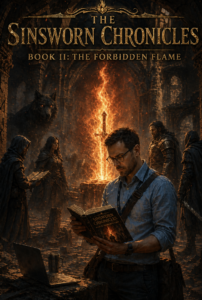
The Sinsworn Chronicles, Book II: The Forbidden Flame belongs on an IT manager’s reading list because it explores the kind of leadership that is forged under pressure. It is a fantasy story, but the emotional weight behind it feels familiar to anyone responsible for guiding people through uncertainty. The book deals with trust, difficult decisions, responsibility, loyalty, risk, courage, and the danger of power without wisdom. Those themes matter deeply in today’s technology landscape.
IT management is not only about systems. According to Information technology management, the discipline includes managing technology resources in alignment with organizational needs and priorities. That means IT managers are not simply keeping computers running. They are helping businesses make better decisions, protect what matters, and move forward without losing control. In that sense, The Forbidden Flame is more than entertainment. It is a mirror for modern leadership.
For readers who enjoy epic fantasy books with deeper meaning, this story offers more than battles, danger, and mystery. It offers a powerful look at what happens when people are forced to lead before they feel ready.
Leadership Under Pressure Reveals Character
Every IT manager knows that leadership is easiest when everything is calm. The real test comes when something breaks, a deadline moves, a security alert hits, or leadership wants answers faster than the team can produce them. Pressure exposes whether a leader creates clarity or confusion.
That is one of the strongest leadership parallels hidden inside The Forbidden Flame. Fantasy often puts characters in impossible circumstances. There is danger, uncertainty, and a constant sense that the next choice could carry a serious cost. That kind of pressure strips away performance and reveals character. The same thing happens inside IT departments.
A strong IT manager cannot lead only when the schedule is clean and the budget is generous. Real leadership shows up when competing priorities collide. It shows up when a business wants innovation, but the infrastructure needs stability. It shows up when team members are exhausted, but the company still needs forward motion.
The best leaders do not pretend pressure is absent. They name it, organize it, and help people move through it. That is why stories like The Forbidden Flame matter. They remind leaders that courage is not the absence of fear. Courage is action with responsibility.
This aligns with what many technology leadership discussions are highlighting now. InformationWeek’s IT Management coverage frequently focuses on the growing pressure around AI adoption, governance, tool sprawl, security concerns, and operational control. These are not small issues. They require IT managers who can stay steady when the environment becomes complicated.
Power Without Governance Creates Danger
One of the most important leadership lessons in The Forbidden Flame is the danger of power without wisdom. In fantasy, forbidden power often carries a cost. It may look useful, impressive, or necessary, but without restraint, it can become destructive. That lesson translates directly into modern technology management.
Today’s IT managers are surrounded by powerful tools. Artificial intelligence, automation, cloud platforms, cybersecurity systems, analytics tools, and integrated workflows can transform a company. They can also create new risks when they are adopted too quickly or without clear oversight.
The point is not that powerful tools are bad. The point is that powerful tools need leadership. They need purpose. They need boundaries. They need governance.
The NIST Cybersecurity Framework exists to help organizations better understand, manage, and reduce cybersecurity risk. That matters because IT managers are no longer only responsible for uptime. They are expected to think about risk, compliance, resilience, and business continuity. In many companies, the IT manager is one of the few people who can see both the technical risk and the business consequence.
That is where The Forbidden Flame becomes especially relevant. The story’s deeper message is not simply that power exists. It is that power must be handled with discipline. IT managers face a similar challenge every day. They must decide when to say yes, when to slow down, when to test, when to secure, and when to protect the organization from moving too fast into something it does not fully understand.
Trust Is the Real Infrastructure
Every company talks about infrastructure, but trust is the infrastructure that holds a team together. Without trust, even the best systems become fragile. People stop reporting problems honestly. Departments hide mistakes. Leaders make decisions with incomplete information. Teams become reactive instead of aligned.
The Forbidden Flame works well for IT managers because it deals with the weight of trust. Characters in a high-stakes fantasy world must decide who can be counted on, who may be hiding something, and who is strong enough to stand with them when circumstances get dangerous. That is not far removed from the reality of leading an IT team.
An IT manager must build trust upward, downward, and across the organization. Executives need to trust the IT manager’s judgment. Team members need to trust that their leader will protect them from chaos where possible and guide them through it when necessary. Other departments need to trust that IT is not the department of “no,” but the department of “let’s do this the right way.”
That kind of trust is earned through consistency. It is built when leaders communicate clearly, follow through, take responsibility, and avoid blaming the team when things get difficult.
This is also why IT leadership continues to evolve. Computerworld’s IT Leadership section regularly covers the changing priorities facing technology leaders, including AI, operations, security, and enterprise strategy. The common thread is that technology leadership now depends heavily on communication and trust. The IT manager who can translate technical reality into business understanding becomes far more valuable.
The Best Leaders Protect the Mission and the People
In The Forbidden Flame, the stakes are not only external. The characters are not simply trying to survive a threat. They are carrying emotional burdens, loyalties, fears, and responsibilities. That is what gives the story weight. The mission matters, but the people inside the mission matter too.
This is one of the most practical lessons for IT managers. It is easy to become so focused on tickets, timelines, migrations, patches, upgrades, budgets, and reports that the people doing the work become invisible. Good leaders refuse to let that happen.
An IT team is not a machine. It is made of people who carry pressure, fatigue, skill, pride, frustration, and ambition. A manager who ignores that will eventually lose momentum. A manager who understands it can build a healthier, stronger team.
Protecting the mission means keeping the business moving. Protecting the people means making sure the team has clarity, reasonable priorities, and the support needed to do good work. Both matter. One without the other creates imbalance.
This is especially important during transformation. CIO’s coverage of digital transformation often emphasizes focus, prioritization, and disciplined execution. That matters because transformation can sound exciting at the executive level while becoming overwhelming at the team level. IT managers are often the bridge between vision and reality.
The Forbidden Flame reminds readers that leadership is not only about moving toward the goal. It is about who you become while carrying the responsibility.
Adaptability Is More Valuable Than Control
IT managers often want control, but real leadership requires adaptability. Plans change. Vendors disappoint. Tools fail. Users resist new systems. Security threats evolve. Business priorities shift. The strongest IT managers are not the ones who expect everything to go perfectly. They are the ones who can adjust without losing the mission.
Fantasy stories are powerful because they force characters into unfamiliar territory. The path is rarely straight. A character may begin with one understanding of the threat and later discover the real danger is deeper, older, or more personal than expected. That kind of movement is similar to technology leadership.
An IT manager may begin a project believing the challenge is technical. Later, they discover the real issue is communication, training, leadership alignment, vendor limitations, poor documentation, or unclear ownership. The leader who adapts wins. The leader who clings too tightly to the original assumption struggles.
Gartner’s 2026 CIO Agenda highlights agility, risk-readiness, and tenacity as critical capabilities for CIOs facing an AI-driven and unstable business environment. That applies to IT managers as well. Agility is not about chasing every new trend. It is about staying clear-minded enough to pivot when the facts change.
The Forbidden Flame speaks to this kind of adaptability. It shows that the path forward is not always obvious, and the right decision may require humility, courage, and the willingness to see the situation differently.
Innovation Needs Moral Clarity
Technology leadership is filled with innovation language. Companies want faster systems, smarter workflows, better automation, cleaner data, stronger security, and more competitive tools. Those are good goals, but innovation without moral clarity can lead to poor decisions.
The Forbidden Flame, as a concept, is a strong metaphor for the modern IT landscape. Some tools are powerful enough to change everything around them. Some decisions create consequences beyond the first implementation. Some shortcuts feel harmless until they become cultural habits.
IT managers must ask practical questions. Does this tool protect our data? Does this process respect the people using it? Does this automation improve the business without creating hidden risk? Does this platform help the company grow in a healthy direction? Does this decision serve the mission, or does it only make us look more advanced?
Forrester’s 2026 technology and security predictions point toward a future where technology and security leaders face pressure to deliver measurable outcomes while managing AI, governance, and emerging threats. That is exactly why moral clarity matters. IT managers are increasingly responsible for decisions that affect privacy, security, productivity, customer trust, and employee experience.
A fantasy story like The Forbidden Flame gives leaders space to think about power, consequence, and responsibility without feeling like they are reading another workplace policy. It reaches the imagination first, and then the lesson settles deeper.
Conclusion
The Sinsworn Chronicles, Book II: The Forbidden Flame deserves a place on every IT manager’s reading list because it speaks to the human side of leadership. It is not a business manual, and that is exactly why it works. It gives readers a story filled with pressure, loyalty, danger, responsibility, and difficult choices. Those themes are deeply relevant to anyone leading a technology team today.
IT managers are asked to do more than maintain systems. They are asked to protect organizations, guide teams, manage risk, adopt new tools wisely, communicate across departments, and make decisions that affect the future of the business. That kind of responsibility requires more than technical knowledge. It requires judgment, courage, patience, and character.
The best fantasy does not pull readers away from real life. It helps them return to real life with sharper vision. The Forbidden Flame does that by showing how leadership is tested when power grows, trust is strained, and the path forward is uncertain.
For IT managers, that makes the book more than a great read. It makes it a leadership reflection wrapped in an unforgettable fantasy journey.